 FabFilter Pro-Q4
FabFilter Pro-Q4
FabFilter Pro-Q4
Just like an amplitude envelope dictates how the amplitude of a note changes over time, other parameters on your synth can be changed over time using envelope modulation. The parameters that can be modulated, or modulation targets, vary from synth to synth. Back in the day there were generally two envelopes on an analog synth, an amplitude envelope and a filter envelope. By now, the envelope has seen pretty much every possible target on a synthesizer you can think of.
There are two ways envelope modulation can be added to a parameter on a synthesizer. Via envelope generators and envelope followers. In this article we'll cover the most common modulation targets and the difference between envelope generators and envelope followers.
We'll mainly refer to Twin 3 for the sake of this article but since all FabFilter creative plug-ins feature a modulation section we will also add some examples of using modulation creatively in Timeless 3 and Saturn 2.
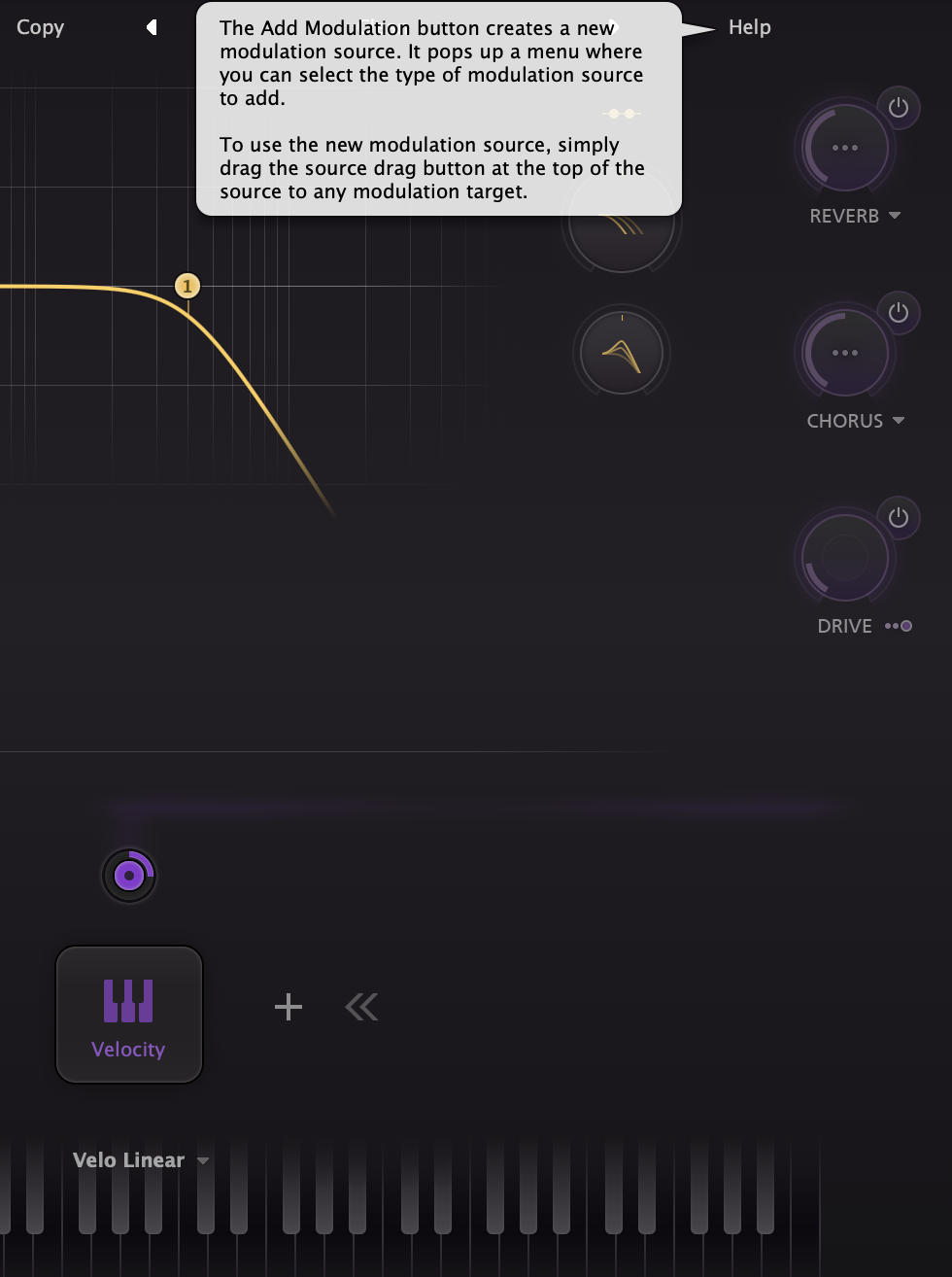 In Twin 3 you can add modulation by clicking the "+" symbol in the bottom of the interface to add a new modulation source. click and drag to your desired target to add modulation.
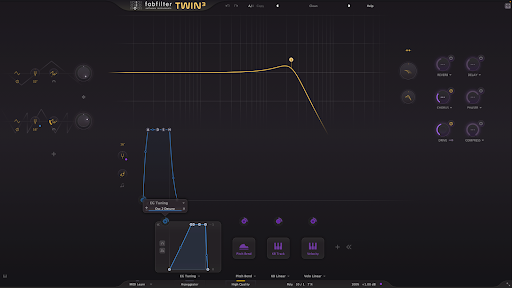 Screenshot of above settings
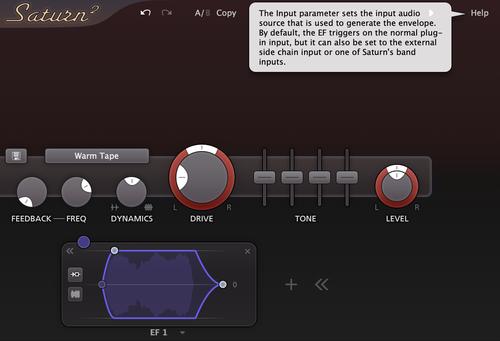 Saturn 2
Let's use an envelope follower with Saturn 2 to mimic a piece of analog hardware, creating saturation as the input level increases.
Timeless 3
Auto ducking is a technique often used on vocals in particular, auto ducking the wet signal of a delay works really well to keep the vocal in front of a mix while allowing the delays and other time-based effects to be heard in the gaps of the vocal performance.
By assigning the envelope follower to the wet level of a delay and reversing the polarity, we can make sure the level of the delay gets turned down automatically in proportion to the input level. The polarity reversal is necessary as we want the level turned down and not up.
Saturn 2
Let's use an envelope follower with Saturn 2 to mimic a piece of analog hardware, creating saturation as the input level increases.
Timeless 3
Auto ducking is a technique often used on vocals in particular, auto ducking the wet signal of a delay works really well to keep the vocal in front of a mix while allowing the delays and other time-based effects to be heard in the gaps of the vocal performance.
By assigning the envelope follower to the wet level of a delay and reversing the polarity, we can make sure the level of the delay gets turned down automatically in proportion to the input level. The polarity reversal is necessary as we want the level turned down and not up.