At the heart of the synthesizer lies the oscillator. The oscillator section is the sound source of your synthesizer and allows you to define the initial pitch and spectrum of your sound.
Oscillators create a repeating waveform at some frequency. This is very similar to what happens in acoustic musical instruments. As we excite a resonant object, such as a guitar string, it vibrates at some frequency, governed by the length of the string. This, in turn, produces a sound with a unique spectrum, governed by the size, shape and construction of the instrument. Oscillators give us a way to mimic this phenomenon, creating our own sounds from scratch.
Almost every synth offers an oscillator section with the basic parameters we discussed in Basics: Subtractive synthesis. However, it is not uncommon to come across a synth that offers additional parameters in the oscillator section that allow you to shape the tone of your synth. Let's have a look at some of the more elaborate features we might come across in an oscillator section.
Oscillator sync
Oscillator sync is a way of making two oscillators work together. We refer to a single journey through the positive and negative stages of a waveform as a cycle or period. If this sounds unfamiliar to you, see Phase: What is it and why does it matter? Oscillator sync utilizes a leader oscillator and a follower oscillator. The leader oscillator forces the follower oscillator to reset every time the leader completes a cycle. The result is that no matter what the pitch of the follower oscillator is, you will always hear the pitch of the leader oscillator. Because the cycle of the follower oscillator is cut short before/after a complete cycle, irregular wave shapes are created, resulting in a more complex timbre.
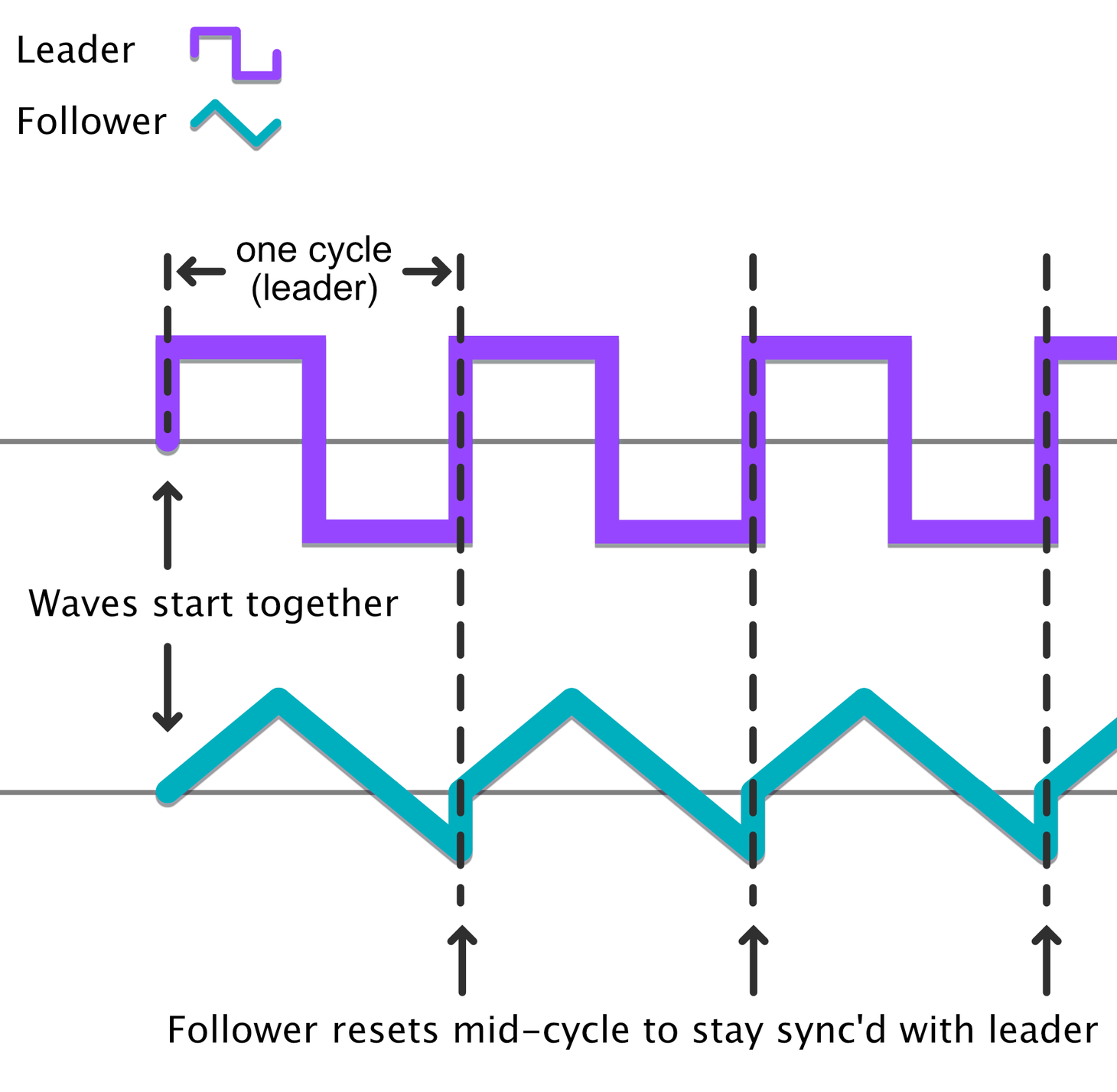
A leader oscillator (square wave) and follower oscillator (triangle wave) moving in sync
Sub-oscillator
A sub-oscillator is an oscillator that plays an octave (or two) lower than the main oscillator. Its pitch cannot be changed independently of the main oscillator. It is often a square or triangle wave. Usually the sub-oscillator is used to fatten up a sound, with the lower fundamental adding support in the bottom octaves and the harmonics (especially for a square wave) adding thickness to the low midrange. Keep in mind that too much low end can make a sound harder to place in the mix.
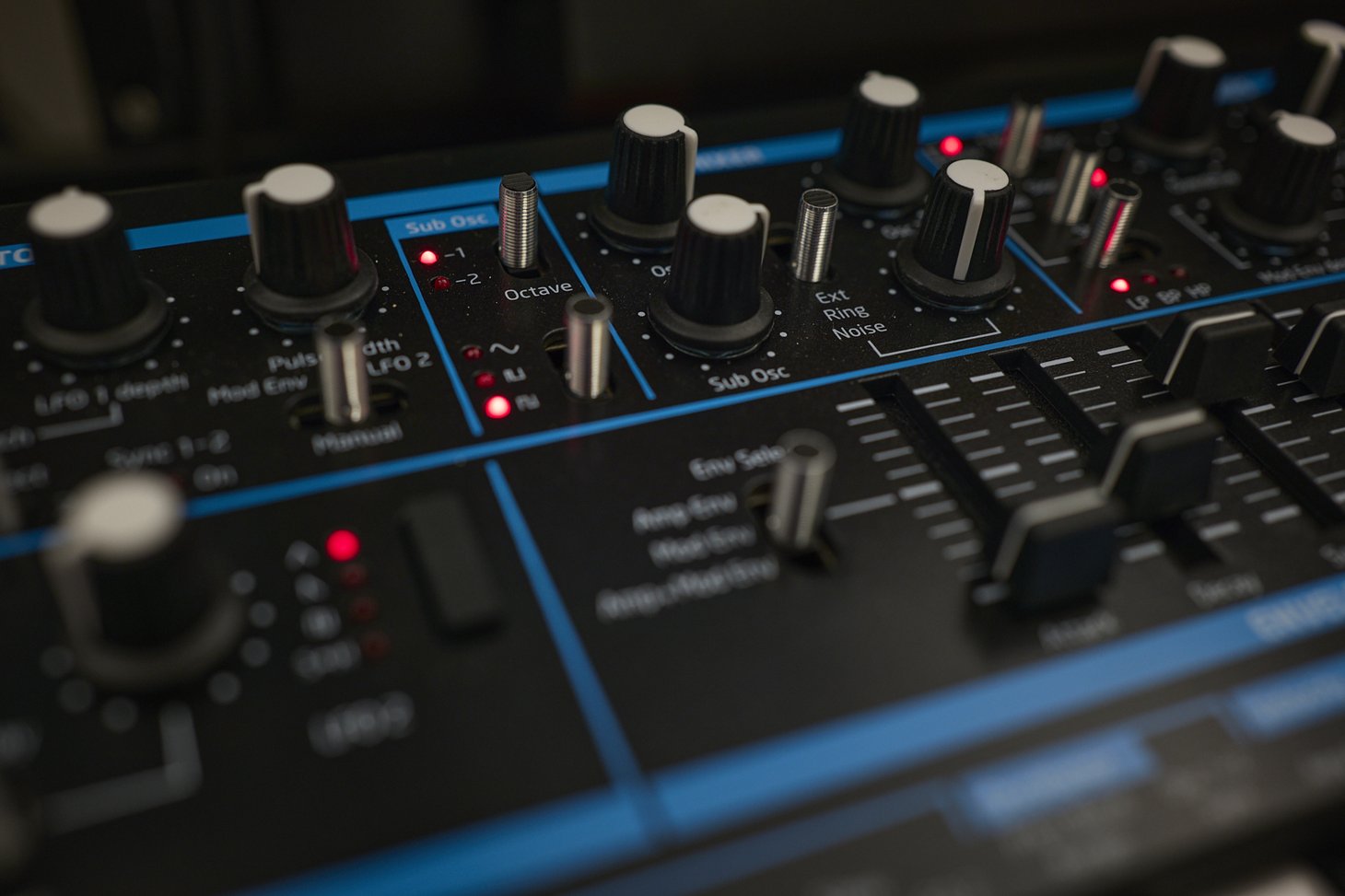
Sub-oscillator controls with options for octave (-1 or -2) and waveform (sine, narrow pulse and square)
Noise oscillator
Noise waveforms are unlike other waveforms because they create a random mixture of frequencies rather than unique pitches. Some synthesizers have different types of noises available, which will have varying frequency balances. White noise is the the most common noise. Pink, red, and brown noise are darker. Blue noise tends to be brighter.
One of the musical uses for white noise is to use it percussively, like for an electronic snare sound or trance lead. Another one is to make a synthesizer sound "older", and works especially well when paired with a triangle wave. One last example would be to use it for FX-type sounds, like wind or explosions. By passing the noise through a filter and envelope we can shape it dramatically, helping it to fulfil its purpose in a musical context.
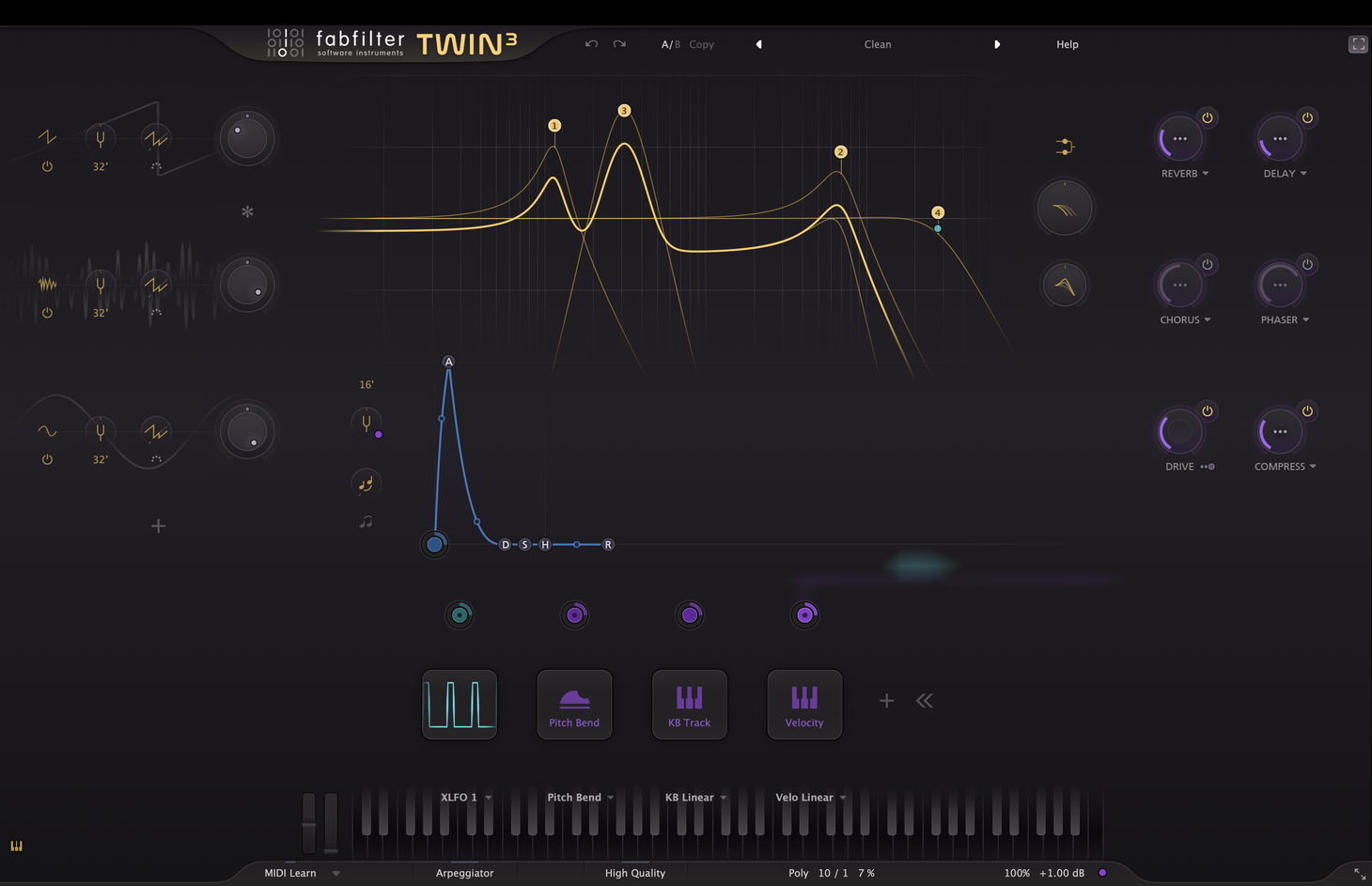
In this next example, all sounds (including FX) were generated using Twin 3; one instance for kick, one for snare and one for hats. Each track has a noise oscillator blended in, with the amount of noise being higher for the snare and hats. By filtering the noise and other oscillators, we can approximate some of the physical components of an acoustic instrument.
For example, on the snare track, we can add some body to the sound by using a sine/triangle oscillator passed through a narrow, more resonant filter shape, and blended in at a lower volume. The noise oscillator is filtered using a low pass filter to remove some of the highest frequencies. Here is a screenshot of the snare patch.
 FabFilter Pro-Q4