 FabFilter Pro-Q4
FabFilter Pro-Q4
FabFilter Pro-Q4
Every sound exists in the context of its surroundings. In most cases we perceive sounds as a combination of the direct sound in conjunction with the sound that is reflected back to us. The amount of time it takes for a sound to dissipate completely is referred to as decay time. This is the reverb's main control as it will determine the type of reverb character. A short decay will result in a small sounding space while a long decay time will result in a big one. In most reverb plug-ins you'll come across, the reverb time is specified as the amount of time it takes for the reverberated sound to drop below -60 dB, also commonly referred to as RT60.
Traditional algorithmic reverbs allow you to manipulate the decay of low and high frequencies independently. In real spaces, high frequencies often dissipate quite quickly while bass frequencies sustain much longer. Having control over low and high decay rates independently allows you to make more natural sounding room models. Determining what kind of character works best for your mix is best judged by your ears, but in general shorter/medium sized rooms/halls will work better for percussive sounds than longer reverbs. Conversely, sustained sounds generally work better with longer decay times. Much like you’d use a traditional EQ to adjust the level for specific frequency bands, FabFilter Pro-R employs a decay rate EQ which allows you to sculpt the decay time per selectable frequency band.
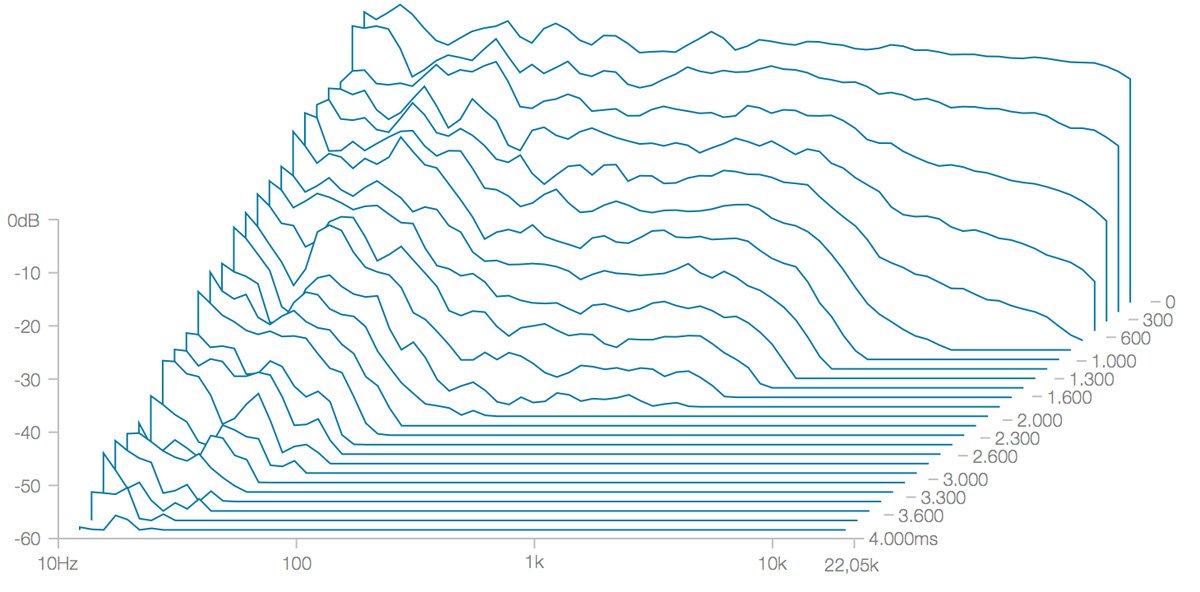 A waterfall plot expressing RT60 for specific frequency bands
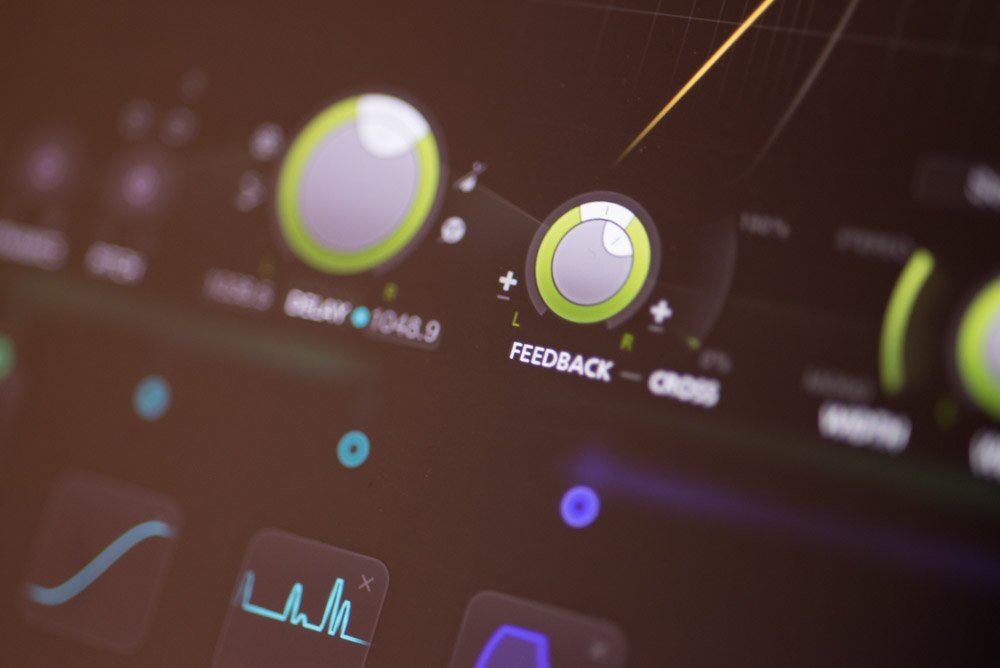
The first reflections occurring from boundaries closest to the sound source are called early reflections. Early reflections generally occur within the first 50 milliseconds and play an important role to create the character and size of a room. The level and brightness of early reflections determine how far away we appear to be from a source. As you get further away from a source, early reflections will be less pronounced and there will be more build-up of late reflections as the sound would have already reflected off multiple surfaces. In an algorithmic reverb, a feedback system is commonly used to create the tail of the reverb. In FabFilter Pro-R, we've simply incorporated a distance knob that automatically strikes a natural balance between the amount of early to late reflections.
 Using a pre- or post-EQ in conjunction with your reverb allows you to benefit from the width and depth introduced by the reverb without obstructing frequency regions that are reserved for other sources. Setting the appropriate cut-off frequency is usually done by finding a point at which you start hearing the filtering clearly, then dialing it back a bit.